top of page
IMG-20191116-WA0076_edited.jpg
IMG_20201029_130402525_HDR.jpg

Cleber J. N. Chaves

Ph.D.

About me

Cleber J. N. Chaves (Ph.D.)

DSC_1307.JPG

I am an eco-evolutionary biologist interested in understanding how ecological interactions, dispersal, and environmental variation shape organisms’ thermal responses and species distributions across space and time. My research asks how populations and species cope with environmental heterogeneity — and how these responses scale up to influence biogeographic patterns and vulnerability to climate change.

I hold a B.Sc. in Biology (2011) and an M.Sc. in Plant Biology (2013) from the Federal University of Minas Gerais (Brazil), and a Ph.D. in Ecology and Biodiversity (2019) from São Paulo State University (Brazil). During my doctoral training, I also conducted a six-month research stay at Technische Universität Dresden (Germany).

A central focus of my current research is the evolution of thermal tolerance and thermal strategies in Pitcairnia flammea, a bromeliad that exemplifies adaptive radiation within the family. Distributed patchily across inselbergs and spanning strong climatic, elevational, and hydric gradients in the Brazilian Atlantic Forest, P. flammea provides a powerful natural system to study local adaptation, dispersal constraints, and the balance between thermal canalization and plasticity. By integrating demographic, physiological, and ecological data, my work aims to connect individual-level thermal responses to broader patterns of species persistence, range limits, and extinction risk under climate change.


My broader research background includes:

  • Thermal tolerance and morphological adaptations

  • Species interactions, including competition and facilitation

  • Epiphyte–host tree dynamics

  • Species Distribution Modeling (SDM)

  • Individual/Agent-Based modeling (IBM/ABM)

I am currently open to new collaborations and opportunities that advance our understanding of eco-evolutionary responses to environmental change.

​​

Get in touch!

Início: Sobre mim

Research

My current research effort covers the following two main topics:

shutterstock_1152328958_edited.jpg

I investigate how organisms respond to spatial and temporal variation in temperature, with an emphasis on how past and ongoing climate change shapes physiological thermal tolerance, thermal strategies, and species distributions. My work focuses primarily on plants and integrates field observations, experiments, and modeling to link individual thermal responses to population persistence and biogeographic patterns.

Epiphytes

I study how biotic interactions and landscape context drive the occurrence, abundance, and functional composition of epiphyte communities. My research explores how interactions across multiple scales influence epiphyte population dynamics, community assembly, and responses to environmental change, with particular emphasis on:

  • Host tree-epiphyte interactions

  • Epiphyte-epiphyte interactions

  • Population dynamics of weeds

  • Individual-based modeling

Thermal responses

IMG_20190118_141615922_HDR_edited.jpg
Início: Pesquisa
Research

Publications

Chaves, C.J.N., Tavares, D.U., Lemos-Silva, I.V., Bento, J.P.S.P., Vilela-Bianchini, H.M., Aecyo, P., Cacossi, T.C., Tavares, M.M., Sabino, G.P., Kamimura, V.A., Santos, W.L., Gonçalves, L.N., Silva, K.T., Mayer, J.L.S., Ribeiro, R.V., Escobar-Escobar, D., Feeley, K.J., Palma-Silva, C., 2026. Canalized to Heat, Plastic to Cold: Adaptive Coordination of Leaf and Seed Strategies in Populations Spanning an Elevational Gradient. New Phytologist.

Chaves, C.J.N., Lemos-Silva, I.V., Tavares, D.U., Aecyo, P., Vilela-Bianchini, H.M., Carvalho, C.C., Ribeiro, R.V., Escobar-Escobar, D., Palma-Silva, C., 2025. From inland vigour to coastal caution: contrasting germination strategies of a tropical hydrochoric bromeliad. Botanical Journal of the Linnean Society.

Palma-Silva, C., Mortati, A.F., Chaves, C.J.N., Leal, B.S.S., Ribeiro, R.V., Pinheiro, F., Ferro, M., Riaño-Pachón, D.M., Mattos, J.S., Tavares, M.M., Aecyo, P., Cacossi, T.C., Schoengart, J., Piedade, M.T.F., Andre, T., 2025. Ecological transcriptomics reveals stress response pathways of a ground‐herb species in a waterlogging gradient of Amazonian riparian forests. Molecular Ecology.

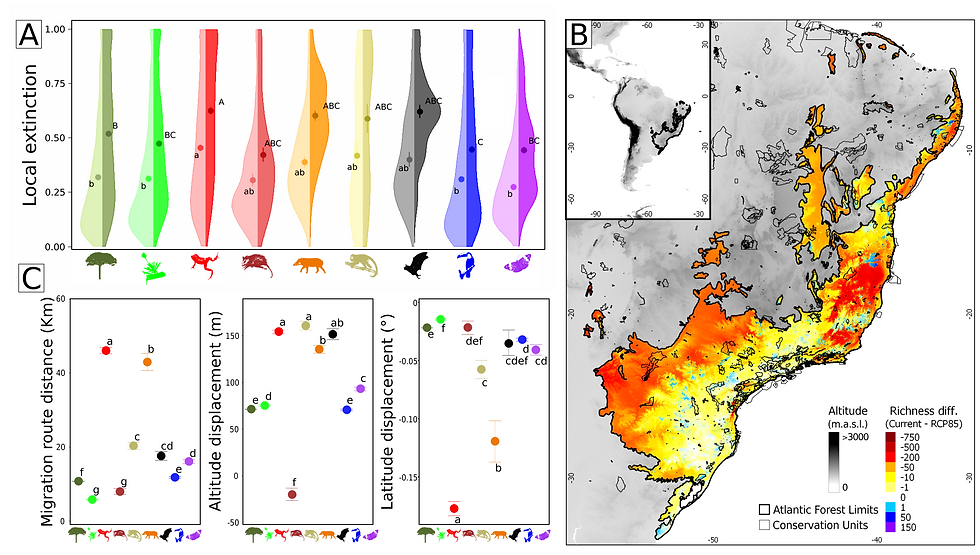
Chaves, C.J.N., Carnaval, A.C., Leal, B.S.S., Monteiro, E.C.S., Palma-Silva, C., 2025. Dispersal Ability Reduces Thermal Specialization and Prevents Climate‐Driven Extinctions in a Neotropical Rainforest. Global Change Ecology.

Chaves, C.J.N., Cacossi, T.C., Matos, T.S., Bento, J.P.S.P., Gonçalves, L.N., Silva, S.F., Silva-Ferreira, M.V., Barbin, D.F., Mayer, J.L.S., Sussulini, A., Ribeiro, R.V., Palma-Silva, C., 2024. Bromeliad populations perform distinct ecological strategies across a tropical elevation gradient. Functional Ecology.

Matos, T.S., Marques, M.S., Chaves, C.J.N., Zandonadi, F.S., Palma-Silva, C., Sussulini, A., 2023. Evaluation of extraction parameters for the analysis of lipid classes in plants. Journal of the Brazilian Chemical Society

Mattos, J.S., Pinheiro, F., Luize, B.G., Chaves, C.J.N., Lima, T.M., Palma-Silva, C., Leal, B.S.S., 2023. The relative role of climate and biotic interactions in shaping the range limits of a neotropical orchid. Journal of Biogeography.

Chaves, C.J.N., Leal, B.S.S, Rossatto, D.R., Berger, U., Palma-Silva, C., 2021. Deforestation reduces the genetic structure of an epiphytic weed across space and time: an IBM approach. Scientific Reports.

Dantas-Queiroz, M.V., Cacossi, T.C., Leal, B.S.S., Chaves, C.J.N., Vasconcelos, T.N.C., Versieux, L.M., Palma-Silva, C., 2021. Underlying microevolutionary processes parallel macroevolutionary patterns in ancient neotropical mountains. Journal of Biogeography

Leal, B.S.S., Chaves, C.J.N., Graciano, V.A., Huacre, L.A.P., Boury, C., Heuertz, M., Palma-Silva, C., 2021. Evidence of local adaptation despite strong drift in a Neotropical patchily distributed bromeliad. Heredity.

Pinheiro, F., Veiga, G.S., Chaves, C.J.N., Cacossi, T.C., Palma-Silva, C., 2021. Reproductive barriers and genetic differentiation between continental and island populations of Epidendrum fulgens (Orchidaceae). Plant Systematics and Evolution.

Chaves, C.J.N., Rossatto, D.R., 2021. Reducing tree density affects interactions between trees and atmospheric Tillandsia species (Bromeliaceae). Austral Ecology.

Chaves, C.J. and Rossatto, D.R., 2020. Unravelling intricate interactions among atmospheric bromeliads with highly overlapping niches in seasonal systems. Plant Biology.

Dantas-Queiroz, M.V., da Costa Cacossi, T., Leal, B.S.S., Chaves, C.J.N., Vasconcelos, T.N., de Melo Versieux, L. and Palma-Silva, C., 2020. Underlying microevolutionary processes parallel macroevolutionary patterns in ancient Neotropical Mountains. bioRxiv.

Leal, B.S.S., Graciano, V.A., Chaves, C.J.N., Huacre, L.A.P., Heuertz, M. and Palma-Silva, C., 2019. Dispersal and local persistence shape the genetic structure of a widespread Neotropical plant species with a patchy distribution. Annals of Botany.

Ramos, F.N., Mortara, S.R., Monalisa‐Francisco, N., Elias, J.P.C., Neto, L.M., Freitas, L., ... Chaves, C.J.N., ... Alcantara,S., 2019. Atlantic epiphytes: A data set of vascular and non‐vascular epiphyte plants and lichens from the Atlantic Forest. Ecology.

Chaves, C.J.N., Aoki-Gonçalves, F., Leal, B.S.S., Rossatto, D.R. and Palma-Silva, C., 2018. Transferability of nuclear microsatellite markers to the atmospheric bromeliads Tillandsia recurvata and T. aeranthos (Bromeliaceae). Brazilian Journal of Botany.

Chaves, C.J.N., Leal, B.S.S. and de Lemos-Filho, J.P., 2018. How are endemic and widely distributed bromeliads responding to warming temperatures? A case study in a Brazilian hotspot. Flora.

Leal, B.S., Chaves, C.J., Koehler, S. and Borba, E.L., 2016. When hybrids are not hybrids: a case study of a putative hybrid zone between Cattleya coccinea and C. brevipedunculata (Orchidaceae). Botanical Journal of the Linnean Society.

Palma-Silva, C., Leal, B.S., Chaves, C.J. and Fay, M.F., 2016. Advances in and perspectives on evolution in Bromeliaceae. Botanical Journal of the Linnean Society.

Chaves, C.J.N., Dyonisio, J.C. and Rossatto, D.R., 2016. Host trait combinations drive abundance and canopy distribution of atmospheric bromeliad assemblages. AoB Plants.

Chaves, C.J.N., Leal, B.S.S. and de Lemos‐Filho, J.P., 2015. Temperature modulation of thermal tolerance of a CAM‐tank bromeliad and the relationship with acid accumulation in different leaf regions. Physiologia Plantarum.

Publications

Contact

Cleber J. N. Chaves, Ph.D.
Postdoctoral Research Fellow

IMG-20191116-WA0047_edited.jpg
Início: Contact

©2019 by cleberchaves. Proudly created with Wix.com

bottom of page